
Salesforce’s Summer ’26 release, which went live on June 15, 2026, is the moment the “agentic enterprise” stops being a Dreamforce keynote phrase and starts being how the platform actually works. Multi-Agent Orchestration lets specialized AI agents collaborate under a single orchestrator. Apex now runs in user mode by default — a security shift every org with custom code needs to audit. Chatter is being quietly retired in favor of Slack. And developers get long-awaited quality-of-life wins like State Managers and real-time LWC previews. In this article, we break down the changes that matter most for admins, developers, and business leaders — and what you should do about each of them before they affect your org.
Every Salesforce release brings hundreds of pages of release notes, but a few releases mark a genuine turning point. Summer ’26 is one of them. Reading through the notes, one theme runs through every product pillar: humans and AI agents are now expected to work side by side, and the platform is being restructured around that assumption.
The clearest signal is in the naming itself: Sales Cloud is now Agentforce Sales, and Service Cloud is now Agentforce Service. This is not cosmetic rebranding — it reflects where Salesforce is investing and how it expects customers to build going forward.
Below are the changes we consider most impactful, grouped by who they affect.
1. Multi-Agent Orchestration: Agents That Work as a Team (Beta)
The headline feature of Summer ’26 is Multi-Agent Orchestration in Agentforce. Until now, an Agentforce agent was essentially a single worker with a bag of actions. If you wanted an agent that handled billing questions, scheduling, and knowledge lookups, you had to cram all of that logic — and all of those instructions — into one agent, which quickly became fragile and hard to maintain.
Summer ’26 changes the architecture. You can now build specialized subagents (a billing agent, a scheduling agent, a knowledge agent) and connect them to a single orchestrator agent that receives the user’s request, reasons about it, and delegates the work to the right specialist.
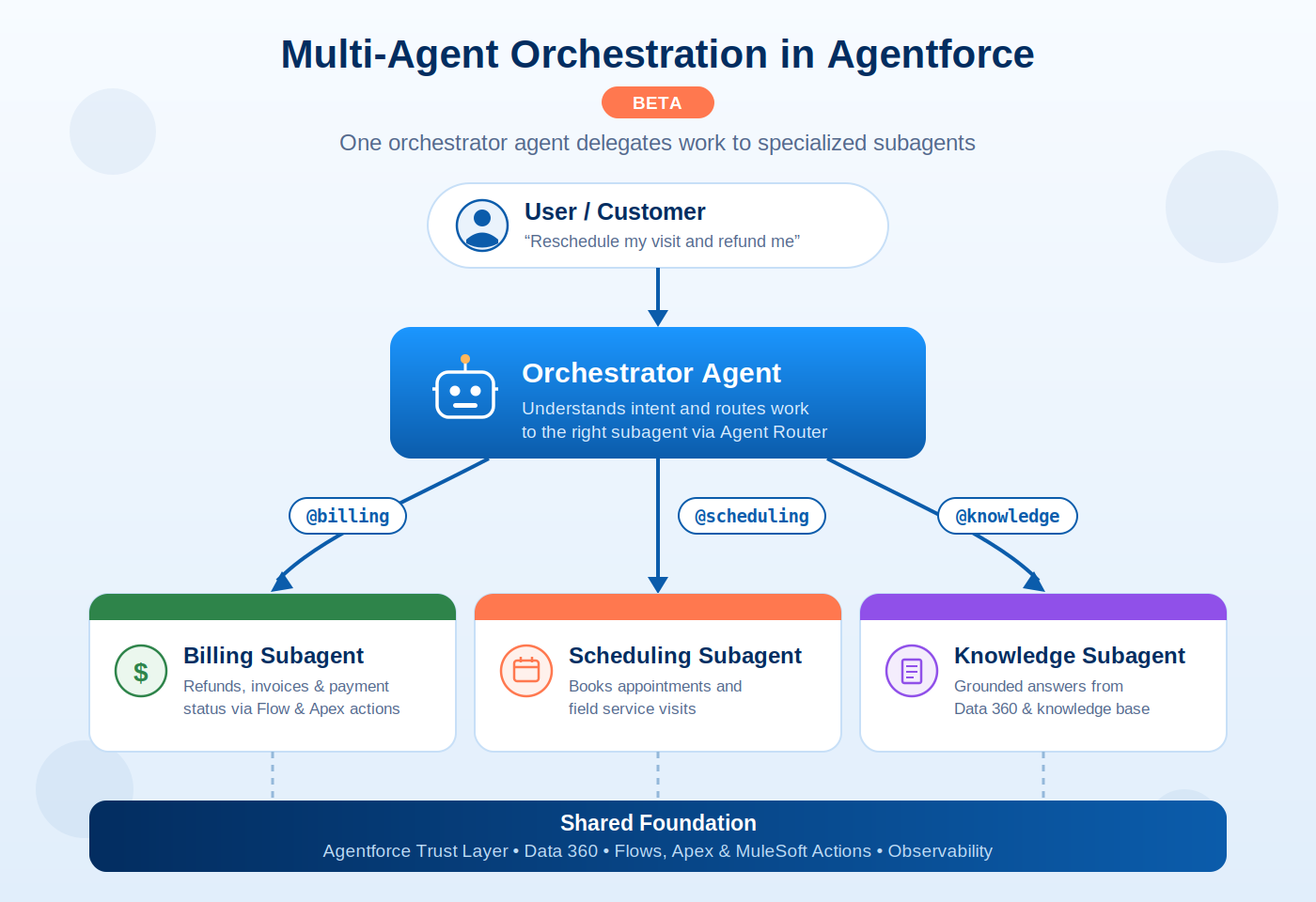
How it works in practice:
In Agent Builder, you attach a specialized agent using Connect Agent as Subagent.
Each subagent gets its own description, which the orchestrator uses to decide when to delegate to it.
Connected subagents appear in the Explorer panel as resources, and if your orchestrator uses Agent Router, you can reference subagents directly in routing instructions using the @ symbol (for example, @billing).
Why this matters: composability. Instead of one monolithic agent that becomes harder to test with every new capability, you get small, focused agents that can be built, tested, versioned, and reused independently — the same architectural discipline we apply to Apex classes and Flows, now applied to AI
A few related Agentforce improvements worth noting in the same release:
Agentforce Voice with SIP is now GA. Voice calls can route to an Agentforce Service agent over SIP rather than PSTN only, which is cheaper and treats voice as just another Omni-Channel channel.
Legacy-to-new Agent Builder upgrades. You can now upgrade agents built in the legacy builder in place — Salesforce converts subagents, actions, system messages, and settings to Agent Script automatically.
Agentforce DX MCP Server and the Vibes IDE. Salesforce is embracing the Model Context Protocol (MCP), an open standard for connecting AI models to tools and data. Agentforce Vibes — Salesforce’s enterprise “vibe coding” environment — now supports additional frontier models (including Anthropic’s Claude and GPT-5) and can generate React apps.
Multi-Agent Orchestration is still in Beta, so we would not put it in front of customers yet. But now is the right time to redesign your agent architecture on paper. If you are planning an Agentforce implementation for late 2026, design for orchestration from day one — retrofitting a monolithic agent into subagents later is far more expensive.
2. Apex User-Mode by Default: The Change That Will Break Things
If you only have time to prepare for one item in this release, make it this one.
Historically, Apex database operations ran in system mode, ignoring the running user’s object permissions, field-level security, and sharing rules unless the developer explicitly enforced them. Summer ’26 flips the default:
Database operations in Apex now run in user mode by default.
Classes with no sharing declaration now default to with sharing instead of without sharing.
This is exactly the kind of change that was easy to skim past in the release notes — and exactly the kind that surfaces weeks later as a mysterious “insufficient access” error in a production integration, a scheduled job that silently processes fewer records, or a trigger that starts failing for a subset of users.
What to do about it:
Inventory your Apex. Identify classes without an explicit sharing declaration and code paths that rely on system-mode behavior (integrations running under an integration user, batch jobs, triggers that update records the current user cannot see).
Be explicit. Where system-mode behavior is genuinely required, declare it deliberately (without sharing, AccessLevel.SYSTEM_MODE) so the intent is documented — not accidental.
Test with real user profiles. Sandbox testing under a System Administrator profile will hide almost every problem this change creates. Test as your actual sales rep, service agent, and integration user profiles.
This is a healthy change — secure-by-default is where the platform should have been years ago. But orgs with a large legacy codebase should treat this as a mini-project, not a checkbox. If you need help auditing your codebase for user-mode readiness, this is precisely the kind of engagement we run at BOTECH.
3. Goodbye Chatter, Hello Slack-First Salesforce
Summer ’26 makes Salesforce’s collaboration strategy unambiguous:
Chatter is turned off by default in all new orgs (Enterprise, Unlimited, and Developer editions). Existing orgs are unaffected, and you can still enable it manually.
Salesforce channels in Slack are now available by default in new Enterprise and Unlimited orgs, with a new Slack panel directly on record pages.
Salesforce is not deleting Chatter — yet. But when a feature is disabled by default for every new customer, the writing is on the wall. Organizations that built processes around Chatter feeds, Case Feed, or Experience Cloud Chatter components should start planning what their collaboration layer looks like in a Slack-first world.
If you are a Slack customer already, the record-page Slack panel is a genuine productivity win — deal rooms and case swarming without leaving the record. If you are not a Slack customer, budget conversations are coming: factor this into your renewal strategy rather than being surprised by it.
4. Developer Highlights: A Maturity Release for LWC
Summer ’26 (API version 67.0) is one of the strongest developer releases in recent memory. The Lightning Web Components platform in particular gets meaningful architectural upgrades:
State Managers are now GA. Data and its logic can finally live outside individual components in a reusable, testable layer. Components on the same page share state cleanly instead of passing events up and properties down through fragile chains.
Real-time LWC previews are GA. You can preview a component as you build it — in VS Code or directly in the browser — without reloading an entire page to see a one-line change. Combined with faster hot reload, the edit-and-preview cycle is dramatically shorter.
Dynamic lists (Developer Preview) render thousands of rows smoothly with built-in virtualization.
lightning/accApi is a new module that lets your components open and drive the Agentforce panel programmatically — a bridge between custom UI and AI agents.
Tighter security defaults: Lightning Web Security now blocks data: URIs for downloads, so file generation needs to be done the supported way.
Two integration-side items deserve attention as well:
SOAP login() retirement is coming. Username/password authentication over SOAP in API versions 31.0–64.0 retires in Summer ’27. Any integration still authenticating this way must move to OAuth (external client apps with JWT tokens) within the next year. Summer ’26 also adds an "Any API Auth" user permission to control who can still use SOAP login, enforced by default in new orgs.
External Services now support enums in OpenAPI specifications — they surface as picklists in Flow action elements, which removes a long-standing annoyance when integrating REST APIs declaratively.
State Managers alone justify revisiting the architecture of any complex Lightning app. If your org suffers from tangled component communication — and most mature orgs do — plan a refactoring pass.
5. Admin and Flow Improvements Worth Knowing
Beyond the headline items, several smaller changes will make day-to-day admin work safer and easier:
Visibility into indirect permission changes. When editing permissions in the enhanced profile view, a new confirmation view highlights any indirect, cascading changes for the admin to approve before saving — closing a gap where permission edits had invisible side effects.
Queue sharing control. A new "Grant Access Using Hierarchies" setting on queues lets you decide, per queue, whether membership grants record access up the role hierarchy — previously an all-or-nothing behavior.
Flow usability upgrades, including more readable data tables, better input components, improved batch-size control, and cleaner error handling for high-volume automation.
AI Content Summarizer component (early stage) — a Lightning page component that surfaces AI-generated summaries of record data automatically, without users clicking anything.
Dark mode expands (Beta) to more editions with SLDS 2 themes, including support for a dark-mode version of your company logo.
6. Data, Analytics, and Security
Data 360 (the evolution of Data Cloud) continues shipping monthly. Summer ’26 adds SOQL improvements for querying data lake objects — including a required dataspace clause for DLO queries and a new option for distinguishing NULL from empty strings — plus Code Extension, which runs custom Python scripts in isolated containers on the platform.
Tableau MCP lets AI agents query Tableau’s analytics engine directly through an open, secure integration, grounded by the Agentforce Trust Layer. This is a big step toward agents that answer analytical questions with real numbers rather than plausible guesses.
Security Mesh (part of Security Center) begins unifying security signals across Salesforce and external partners like Okta — with CrowdStrike integration on the roadmap — turning scattered alerts into consolidated risk scores. Security Center Essentials gives every customer a baseline security dashboard with no complex setup.
What Should You Do Now?
Our recommended priority order for most orgs:
Audit your Apex for the user-mode default change. This is the item most likely to cause production incidents if ignored.
Check your integrations for SOAP login(). You have until Summer ’27, but OAuth migrations always take longer than planned.
Review the enforced release updates — including the WCAG 2.2 accessibility updates for page headers and modals at high zoom levels — in a sandbox before they reach production.
Prototype Multi-Agent Orchestration in a Developer or sandbox org if Agentforce is on your roadmap, and design your agent architecture around subagents from the start.
Decide your Chatter exit strategy if your org relies on it — even though existing orgs are unaffected today.
Conclusion
Summer ’26 is the release where Salesforce’s agentic vision becomes infrastructure. The renaming of core clouds, the composable multi-agent architecture, the MCP-based developer tooling, and the secure-by-default Apex model all point in the same direction: a platform where AI agents are first-class citizens, governed by the same security and observability standards as human users.
For customers, the opportunity is real — but so is the preparation work. The orgs that benefit most from this release will be the ones that treat it as an architectural checkpoint, not just a feature drop.
If you would like help assessing how Summer ’26 affects your org — from an Apex user-mode audit to designing your first multi-agent Agentforce implementation — get in touch with BOTECH. Turning platform changes into business advantage is what we do.
This article reflects features available in the Salesforce Summer ’26 release (API v67.0), generally available June 15, 2026. Multi-Agent Orchestration and several other features noted above are in Beta or Developer Preview; consult the official release notes before relying on them in production.
